
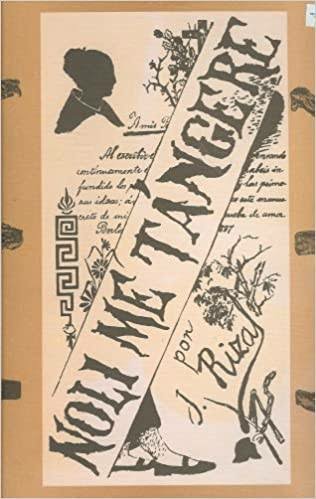
Novel Written by: Jose Rizal
Originally published in Spanish in 1887, Noli Me Tangere (Touch Me Not) is the satirical fiction novel written by Filipino author and national hero Jose Rizal. Set in the Philippines, the story follows Juan Crisostomo Ibarra, a mestizo who ventures to revisit his past and watch history play out before his eyes. The novel was written during the colonization of the Philippines by Spain, and is seen as a public rebuke of the oppressive ruling government and injustices of the Catholic priests. Now more commonly published in the Tagalog or English language, the novel is the first in a trilogy of books, followed by El Filibusterismo and the unfinished Makamisa. Noli Me Tangere and its two sequels have become the national epic of the Philippines, as well as required reading for school students throughout the country. The title refers to the Latin phrase spoken by Jesus to Mary Magdalene upon his resurrection.
Narrated in the third-person perspective, the story begins in the Philippines. Captain Tiago, a wealthy socialite, holds a dinner party to welcome Juan Crisostomo Ibarra back to the Philippines. Ibarra, a native mestizo, has spent the past seven years studying in Europe. During dinner, Ibarra learns his father, Don Rafael, died recently of unknown causes. Ibarra is berated by Friar Father Damaso for learning abroad what he could have learned at home. Ibarra holds his tongue and leaves the party to visit his fiancée Maria Clara, Tiago’s daughter. En route, Ibarra chats with Civil Guard Senor Guevara, who explains that Rafael died in jail after being imprisoned for accidentally killing a tax collector who was abusing a boy in the street. Ibarra travels to his hometown, San Diego, accompanied by Clara. A large “All Souls Day” festival is held commemorating purgatorial souls, which Ibarra finds immoral due to profiting on people’s pain. Ibarra finds the increased influence of the Catholic Church troubling. Father Salvi is an example of the corruption, using his religious post to fine people who don’t attend church.
Ibarra learns from a schoolmaster of Father Damaso’s curricular meddling. Damaso insists on teachers beating children as discipline, and bans teaching Spanish in favor of the native Philippine language, Tagalog. As alternative, Ibarra plans to build a secular school like the one Rafael always wished for. Ibarra consults with church and government officials, fully intending to ignore their influence once the school’s built. Ibarra visits the Catholic cemetery and learns Damaso had Rafael’s body exhumed, which has since been dumped in a lake. During the fiesta, Ibarra and local officials celebrate the opening of the new school. As Damaso blesses the building with a sermon, the mysterious Elias arrives. Ibarra once saved Elias’s life during a fishing expedition. Elias informs Ibarra that the others plan to kill Ibarra during the school’s christening. Ibarra disbelieves, but when a large boulder comes rolling at him as Elias suggested, Elias shoves the man responsible in the way. The man dies, saving Ibarra’s life. The festival continues, but Ibarra is now aware of his foes.
At a dinner celebration held by Ibarra that night, Damaso arrives uninvited and begins insulting the new school, spouting racial insults to Filipinos as “indios,” and besmirches Rafael’s death. The latter remark prompts Ibarra to attack Damaso, raise a knife to him and tell everyone Damaso exhumed Rafael’s corpse. Ibarra nearly kills Damaso but Clara stops the blade before it stabs him. Afterwards, Ibarra is excommunicated. Tiago cancels the wedding of Ibarra and Clara, and betroths his daughter to the Spaniard Linares. The Captain General visits San Diego from Spain, and is begged to punish Ibarra. Since the General supports Ibarra’s school project, he refuses punishment and lifts the excommunication. Father Salvi hires Lucas, brother of the deceased man who meant to kill Ibarra with the boulder, to frame Ibarra. Salvi is in love with Clara, and orchestrates an attack on the military barracks that he blames on Ibarra. Salvi intends to take credit for saving the town from the attack he secretly started.
Following the siege, Ibarra is arrested as planned. He’s jailed and found guilty based on a vague letter he wrote to Clara. Elias returns and busts Ibarra out of prison and they escape on a boat. Before fleeing town, Ibarra climbs onto Clara’s patio and bids adieu. Clara explains the she was blackmailed into releasing the letter which led to Ibarra’s imprisonment. A man told Clara that her real father is Damaso, not Tiago. Clara relinquished the letter in order to keep this a secret from Tiago and to honor her deceased mother. Clara expresses deep regret for her betrayal and reinforces her undying love for Ibarra. Ibarra and Elias bid farewell and begin rowing into the night. As they travel, the debate the merits of revolution and whether a change within this system is better than outright overthrowing it. During their discussion, the men are attacked by another boat. As a distraction, Elias decides to leap off the boat while Ibarra continues rowing. Elias tells Ibarra to meet him on Christmas Eve in San Diego, where Ibarra’s grandfather is buried with his family fortune. Elias dives into the water and is chased by the boat until the attackers spot blood in the water and assume Elias is dead.
In San Diego, Clara tells Damaso she cannot marry Linares because she’s not in love with him. Clara cites a newspaper falsely claiming Ibarra’s death as the reason she no longer wishes to live, and joins a convent as a result. On Christmas Eve, Elias appears in the woods to meet Ibarra, who never shows up. Elias is wounded and tells the young Basilio that he is about to die. Elias asks Basilio to burn his corpse along with Basilio’s mother’s, Sisa’s, on a pyre. As Elias looks up to the sky dying, he utters: “I die without seeing dawn’s light shining on my country…You, who will see it, welcome it for me…don’t forget those who fell during the nighttime.” Ibarra’s fate remains a mystery.
Source: https://www.supersummary.com/noli-me-tangere/summary/
 mimirnotes