
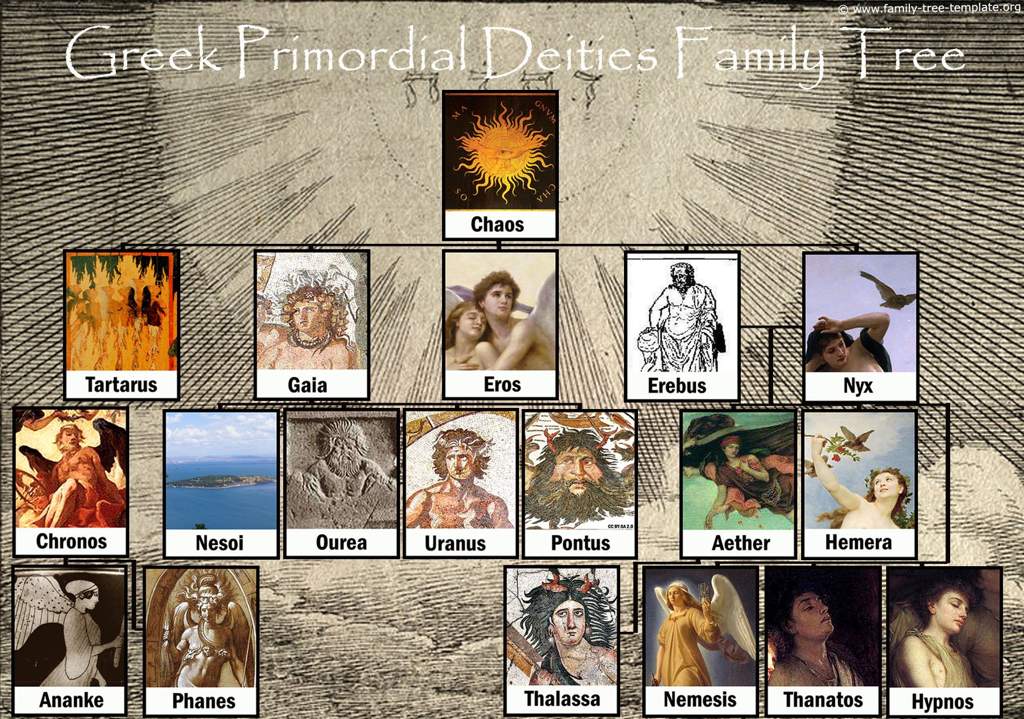
Primordial Gods or Deities
In Greek mythology, the primordial deities are the first generation of gods and goddesses. These deities represented the fundamental forces and physical foundations of the world and were generally not actively worshipped, as they, for the most part, were not given human characteristics; they were instead personifications of places or abstract concepts.
Chaos (Void)
In some variations of Hesiod’s creation myth, in Greek mythology, Chaos is the first being to ever exist. Chaos is both seen as a deity and a thing, with some sources seeing chaos as the gap between Heaven and Earth. In some accounts Chaos existed first alongside Eros and Nyx, while in others Chaos is the first and only thing in the universe. In some stories, Chaos is seen as existing beneath Tartarus. Chaos is the parent to Night and Darkness.
Aether (Light)
He is one of the primordial deities. Aether is the personification of the “upper sky”. He embodies the pure upper air that the gods breathe, as opposed to the normal air (Ancient Greek: ἀήρ, Latin: aer) breathed by mortals
Like Tartarus and Erebus, Aether may have had shrines in ancient Greece, but he had no temples and is unlikely to have had a cult.
Erebus (Darkness)
Erebus, was often conceived as a primordial deity, representing the personification of darkness; for instance, Hesiod‘s Theogony identifies him as one of the first five beings in existence, born of Chaos.
Nyx (Night)
A shadowy figure, Nyx stood at or near the beginning of creation and mothered other personified deities such as Hypnos (Sleep) and Thanatos (Death), with Erebus (Darkness). Her appearances are sparse in surviving mythology, but reveal her as a figure of such exceptional power and beauty that she is feared by Zeus himself.
Hemera (Day)
She was the personification of day and one of the Greek primordial deities. She is the goddess of the daytime and, according to Hesiod, the daughter of Erebus and Nyx (the goddess of night).
Thalassa (Sea)
Gaius Julius Hyginus described her in the preface to his Fabulae as daughter of Aether and Hemera (Fab. Praef., 2). With her male counterpart Pontus, she spawned the storm gods and the tribes of fish. Fables were devoted to her by Aesop and she was to be depicted in both artistic and literary works during the Common Era.
Gaia (Earth)
Gaia was one of the first beings to be formed from Chaos in Hesiod’s theogony, and parthenogenetically gave birth to Heaven, who would later become her husband and her equal, the Sea, and to the high Mountains.
Gaia is a mother earth figure and is seen as the mother of all the gods, while also being the seat on which they exist. Gaia is the Greek Equivalent to the Roman goddess, Tellus / Terra. The story of Uranus’ castration at the hands of Cronus due to Gaia’s involvement is seen as the explanation for why Heaven and Earth are separated. In Hesiod’s story, Earth seeks revenge against Heaven for hiding her children the Cyclopes deep within her, Gaia then goes to her other children and asks for their help to get revenge against their cruel father; of her children, only Cronus, the youngest and “most dreadful” of them all agrees to do this. Gaia plans an ambush against Uranus where she hides Cronus and gives him the sickle to castrate him. From the blood Gaia again become pregnant with the Furies, the Giants, and the Melian nymphs. Cronus goes on to have six children with his sister, Rhea; who become the Olympians. Cronus is later overthrown by his son, Zeus, much in the same way he overthrew his father. Gaia is the mother to the twelve Titans; Okeanus, Kois, Kreios, Hyperion, Iapetos, Theia, Rhea, Themis, Mnemosyne, Phoibe, Tethys, and Cronus.
Later in the myth, after his succession, Cronus learns from his mother and father that his own son (Zeus) will overthrow him, as he did Uranus. To prevent this, Cronus swallowed all of his children with his sister Rhea as soon as they were born. Rhea sought out Gaia for help in hiding her youngest son, Zeus, and gave Cronus a rock instead to swallow. Zeus later went on to defeat his father and become the leader of the Olympians.
After Zeus’s succession to the throne, Gaia bore another son with Tartarus, Typhon, a monster who would be the last to challenge Zeus’s authority.
Sky and Earth have three sets of children: the Titans, the Cyclopes, and the Hecatoncheires
Uranus (Sky)
He was the primal Greek god personifying the sky and one of the Greek primordial deities. Uranus is associated with the Roman godCaelus. In Ancient Greek literature, Uranus or Father Sky was the son and husband of Gaia, the primordial Earth Mother (Mother Earth).
Ourea (Mountains)
Oúrea, lit. ‘mountains’, plural of Οὖρος) were progeny of Gaia, members of the Greek primordial deities, who were the first-born elemental gods and goddesses. The ourea are also referred to by their Roman name, Montes. They were produced alongside Ouranos, the sky, and Pontos, the sea.
Pontus (Sea)
He was an ancient, pre-Olympian sea-god, one of the Greek primordial deities. Pontus was Gaia‘s son and has no father; according to the Greek poet Hesiod, he was born without coupling, though according to Hyginus, Pontus is the son of Aether and Gaia.
Tartarus (Underworld)
Tartarus is described by Hesiod as both a primordial deity and also a great abyss where the Titans are imprisoned. Tartarus is seen as a prison, but is also where Day, Night, Sleep, and Death dwell, and also imagined as a great gorge that’s a distinct part of the underworld. Hesiod tells that it took nine days for the Titans to fall to the bottom of Tartarus, describing how deep the abyss is. In some versions Tartarus is described as a “misty darkness” where Death, Styx, and Erebus reside.
Eros (Love) (in later myths, the name of Aphrodite and Ares‘ son)
Eros is the god of love in Greek mythology, and in some versions of Greek mythology, is one of the primordial beings that first came from Chaos. In Hesiod’s version, Eros was the “fairest among the immortal gods … who conquers the mind and sensible thoughts of all gods and man kind.”
Nemesis (Retribution)
Nemesis is the goddess who enacts retribution against those who succumb to hubris, arrogance before the gods.
Nemesis was widely used in the Greek tragedies and various other literary works, being the deity that would give what was due to the protagonist. She was often called “Goddess of Rhamnous”, an isolated place in Attica, where a temple was attributed to her.
Pontus (Sea God)
He was an ancient, pre-Olympian sea-god, one of the Greek primordial deities. Pontus was Gaia‘s son and has no father; according to the Greek poet Hesiod, he was born without coupling, though according to Hyginus, Pontus is the son of Aether and Gaia.
Ananke (Inevitability)
She is the personification of inevitability, compulsion and necessity. She is customarily depicted as holding a spindle.
Ananke is considered the most powerful dictator of fate and circumstance; mortals as well as gods respected her power and paid her homage. Sometimes considered the mother of the Fates, she is thought to be the only being to influence their decisions.
Chronos (Time)
Chronos also spelled Khronos or Chronus, is the personification of time in pre-Socratic philosophy and later literature.
Nesoi (Island)
Nesoi were the goddesses of islands. Each island was said to have its own personification. They were classified as one of the ancient elemental Greek primordial deities.According to Callimachus,the Nesoi were thought to have been Ourea who were cast under the sea during one of Poseidon‘s rages.
Phanes (Creation)
He was the mystic primeval deity of procreation and the generation of new life, who was introduced into Greek mythology by the Orphic tradition; other names for this Classical Greek Orphic concept included Ericapaeus
Achlys (Misery)
Achlys in the Hesiodic Shield of Heracles, is one of the figures depicted on Heracles‘ shield, perhaps representing the personification of sorrow. In Homer, achlys is the mist which fogs or blinds mortal eyes (often in death)
Aion (Eternity)
He is a Hellenistic deity associated with time, the orb or circle encompassing the universe, and the zodiac
Sometimes, he is greek equivalent of Chronos and Phanes
Moirai (Destiny)
They were the incarnations of destiny; their Roman equivalent was the Parcae (euphemistically the “sparing ones”), and there are other equivalents in cultures that descend from the Proto-Indo-European culture.
Moros (Doom)
He is the ‘hateful’ personified spirit of impending doom, who drives mortals to their deadly fate. It was also said that Moros gave people the ability to foresee their death. His Roman equivalent was Fatum
“First Chaos came to be, but next… Earth… and dim Tartarus in the depth of the… Earth, and Eros…”
Hesiod’s Theogony (700 BCE)
NOTE: Other gods are not included in this page but in the family tree because some of them are not primordial deities and they are a next generation
If the other gods are included here but not in the family tree, it is because they are minor deities but still primordial deities
 mimirnotes